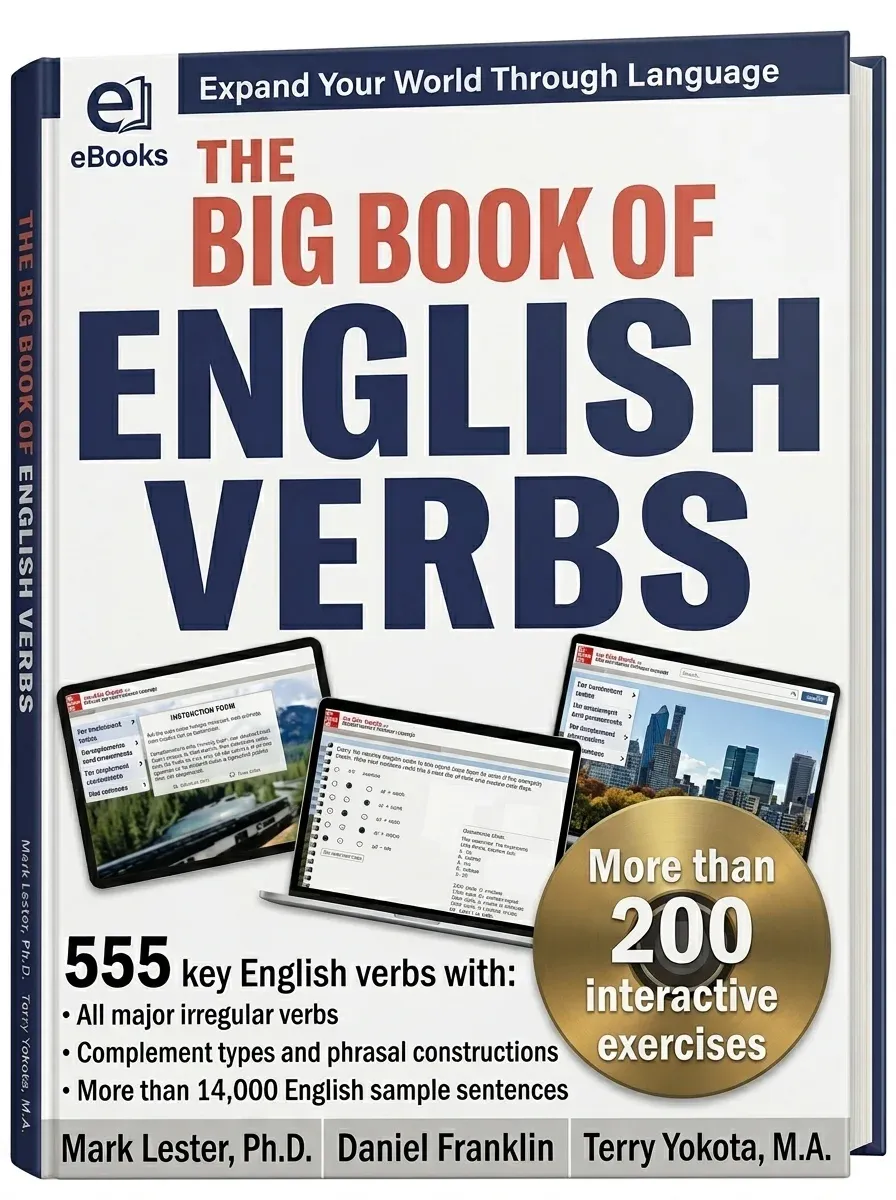
The Big Book of English Verbs is the most comprehensive verb resource available for English learners, teachers, and writers. It provides full conjugations, usage examples, and essential grammar rules for over 555 verbs, making it an indispensable desktop reference.
H2: The Scope and Scale of The Big Book of English Verbs
The Big Book of English Verbs contains complete conjugations for 555 fully conjugated English verbs, from common regular verbs like “walk” to complex irregulars like “to be” and “to have.” Unlike pocket dictionaries that list only principal parts, this book shows every tense and mood: present, past, future, perfect, progressive, and conditional. Each verb occupies its own full-page chart, making lookup instantaneous. Beyond the core 555, the book includes an index of over 2,500 additional verbs, cross-referencing each to one of the 555 model conjugations. For example, “justify” follows the pattern of “try.” This expansive scope means learners rarely encounter an English verb not covered. The Big Book of English Verbs thus functions as both a dictionary and a textbook, serving beginners and advanced users equally well.
H2: How The Big Book of English Verbs Handles Irregular Verbs
Irregular verbs cause the most frustration for English learners, and The Big Book of English Verbs addresses this with exceptional clarity. The book dedicates special attention to the 200-plus irregular verbs in English, including tricky patterns like sing-sang-sung and begin-began-begun. Each irregular verb receives its own full conjugation chart, showing base form, past simple, and past participle. Sidebar notes highlight common errors, such as confusing “lie” (to recline) with “lay” (to place). Additionally, the book includes a quick-reference table of the 50 most frequent irregulars printed on the inside covers. For verbs with multiple meanings, example sentences demonstrate correct usage in context. By isolating irregular patterns and providing ample repetition through charts, The Big Book of English Verbs transforms a memorization nightmare into a manageable system. Students finally understand why “swim” becomes “swam” but “climb” remains regular.
H2: Phrasal Verbs and Prepositions in The Big Book of English Verbs
Beyond simple conjugations, The Big Book of English Verbs extensively covers phrasal verbs—combinations of verbs and prepositions that change meaning entirely. For instance, “give up” differs completely from “give in” or “give out.” The book lists common phrasal constructions for each main verb, with example sentences showing transitive and intransitive uses. A separate 50-page section indexes over 1,000 phrasal verbs alphabetically by particle: up, down, off, on, over, through. This feature is rare among verb reference books. Additionally, The Big Book of English Verbs explains which prepositions follow which verbs (depend on, insist upon, belong to). For non-native speakers, preposition choice is notoriously difficult; this book provides definitive answers. ESL teachers frequently call this phrasal verb section alone worth the purchase price, as no other single volume organizes this information so accessibly.
H2: Using The Big Book of English Verbs for Writing and Editing
Writers and editors keep The Big Book of English Verbs on their desks for good reason. When drafting, writers often hesitate over subjunctive mood (“If I were” versus “If I was”) or tricky passive constructions. The book resolves such questions instantly. Its 555 verb charts include rare forms like the present subjunctive, past subjunctive, and imperative mood. For editors, the book serves as a final authority for British versus American verb differences, such as “spell” becoming “spelt” in UK English but “spelled” in US English. The introduction also explains verb aspect (perfective versus imperfective) in plain English, not academic jargon. Creative writers use the book to vary tense patterns across paragraphs intentionally. Unlike online conjugators that occasionally contain errors, The Big Book of English Verbs is meticulously edited and printed. For any serious English user, this reference prevents embarrassing mistakes and enriches stylistic range.
H2: Limitations and Best Uses of The Big Book of English Verbs
No single volume is perfect, and The Big Book of English Verbs has practical limitations. The book is heavy—over 600 pages—making it impractical for backpack travel. It also excludes rare, archaic, or technical verbs (such as “abrogate” or “exculpate”), focusing instead on everyday and academic vocabulary. Additionally, the book assumes users already understand basic grammatical terminology; absolute beginners may need a companion grammar guide. Best use involves keeping The Big Book of English Verbs at a home desk or classroom reference station. Use it to prepare for exams, check homework, or settle grammar disputes. ESL students should work through one verb family per week, writing original sentences. Teachers can photocopy individual verb charts for handouts. For mobile needs, consider the digital edition. Despite these limitations, The Big Book of English Verbs remains the gold standard for English verb reference, unmatched in breadth and clarity.