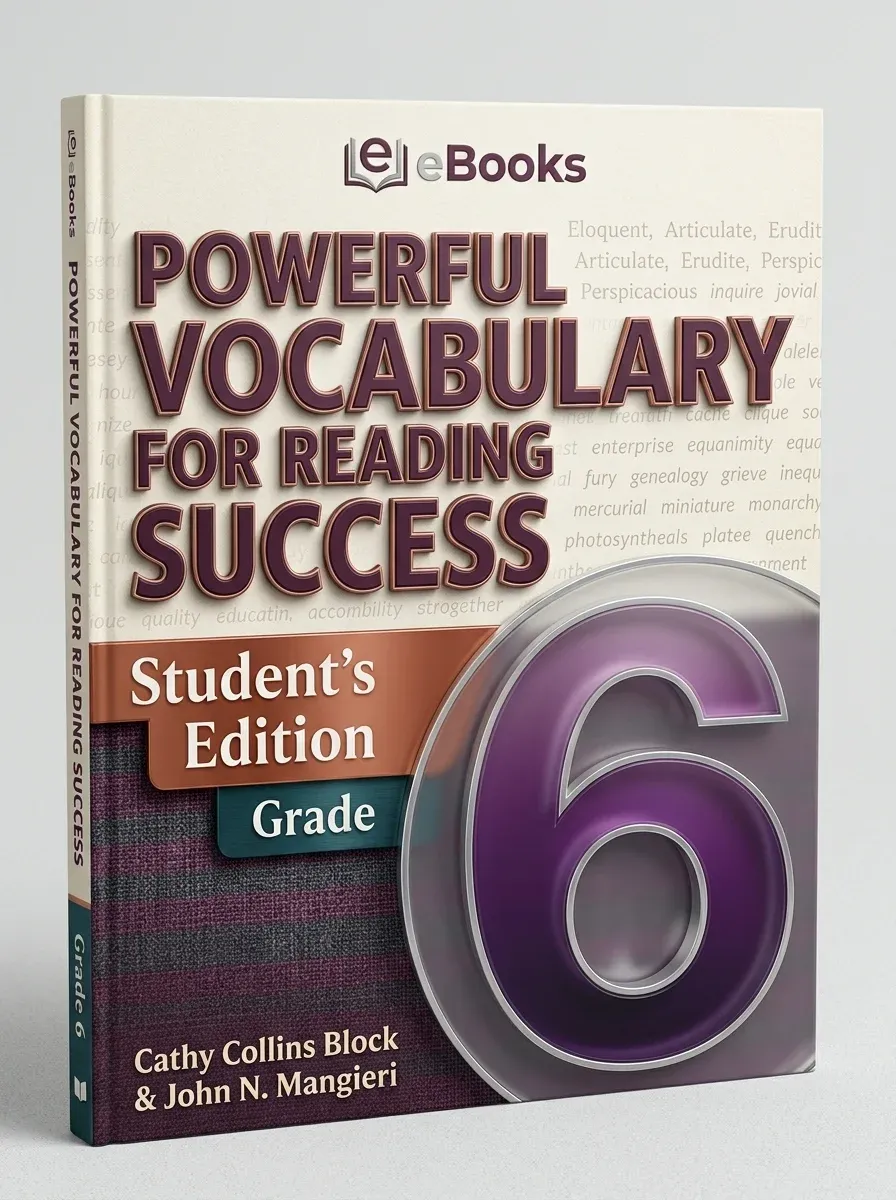
Powerful Vocabulary Student’s Book 6 is an advanced vocabulary builder for upper-intermediate to proficient English learners. This book focuses on high-frequency academic, professional, and literary words through context-based learning, word families, and collocations. Designed for self-study or classroom use, it helps learners express ideas with precision and fluency. Below, we explore five key features using this comprehensive resource.
H2: Systematic Word Expansion Through Thematic Units
Powerful Vocabulary Student’s Book 6 organizes vocabulary into 20 thematic units such as “Persuasion,” “Innovation,” and “Ethics.” Each unit introduces 15–20 target words not through random lists but through engaging reading passages and dialogues. Students encounter terms like advocate, deterrent, or empirical in natural contexts. Following the reading, multiple exercises reinforce meaning, usage, and word families (noun, verb, adjective, adverb forms). This thematic clustering aids memory retention by creating mental associations. Unlike alphabetical glossaries, this approach mimics how native speakers learn—by topic. By completing all units, learners actively master over 350 sophisticated words, dramatically improving both spoken and written expression.
H2: Collocations and Phrase-Based Learning
Knowing a word’s definition is insufficient; Powerful Vocabulary Student’s Book 6 emphasizes collocations—words that naturally pair together. Each chapter dedicates specific exercises to common pairings like reach a consensus, pose a challenge, or yield results. Students learn why “strong coffee” is correct but “powerful coffee” sounds unnatural. The book also teaches fixed expressions and phrasal verbs relevant to academic and workplace settings. Fill-in-the-blank, matching, and sentence rewrite tasks drill these patterns until automatic. By mastering collocations, learners sound more native-like and reduce translation errors from their first language. This phrase-based approach directly improves IELTS, TOEFL, and Cambridge exam scores, where natural word partnerships are heavily evaluated.
H2: Context Clues and Dictionary Independence
Powerful Vocabulary Student’s Book 6 trains students to infer meaning without constant dictionary use. Each unit begins with a strategy lesson: using antonyms, examples, cause-effect signals, or word roots (Latin/Greek) to decode unfamiliar terms. For instance, learners discover that benevolent contains the root bene- (good) and vol (wish), predicting positive meaning. Timed reading passages then require students to guess 5–8 new words before checking a glossary. This skill is crucial for exams where dictionaries are banned and for real-world reading of articles or reports. Repeated practice builds confidence, speeds up reading comprehension, and transforms learners into autonomous vocabulary acquirers rather than passive list memorizers.
H2: Active Production and Writing Integration
Receptive knowledge (understanding a word) differs from productive use (using it correctly). Powerful Vocabulary Student’s Book 6 bridges this gap through writing tasks. After each unit, learners complete sentence creation, paragraph rewriting, and short essay prompts using the target vocabulary. For example, students must replace weak words (good, bad, nice) with precise alternatives (beneficial, detrimental, exquisite). Peer review checklists highlight correct collocation and register (formal vs. informal). A separate answer key provides model sentences for self-correction. By forcing active recall, these exercises move vocabulary from short-term to long-term memory. Students who complete all writing assignments leave the book able to articulate nuanced arguments, describe processes, and persuade readers effectively.
H2: Self-Assessment and Spaced Repetition
Finally, Powerful Vocabulary Student’s Book 6 incorporates scientific memory principles. Every three units includes a review section with cross-unit quizzes, synonym/antonym matching, and cloze passages. A personalized “Words I Still Miss” log allows learners to track challenging items. The book recommends spaced repetition schedules (review after 1 day, 1 week, 1 month) using digital flashcards or handwritten cards. Two comprehensive final tests simulate exam conditions, with answer keys explaining common errors. This AEO-optimized structure answers the critical learner question: “How do I not forget these words?” By systematically revisiting vocabulary, students achieve durable mastery—not just short-term cramming. The result is lasting eloquence for academic writing, professional emails, and everyday conversations.